
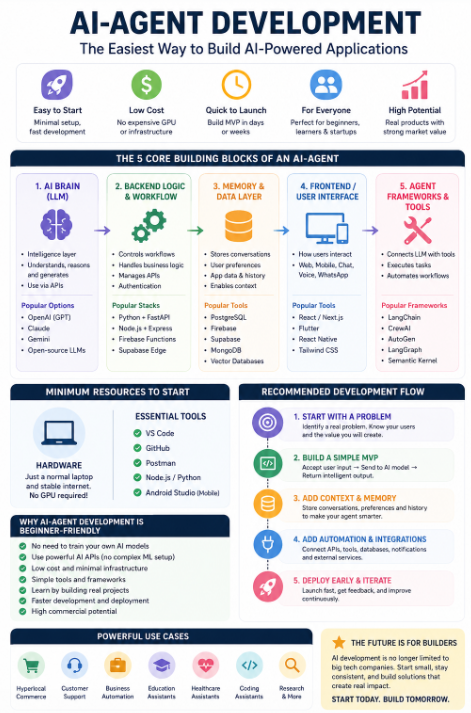
The provided article outlines a modern roadmap for AI-agent development, emphasizing that creating intelligent applications no longer requires massive infrastructure or specialized machine learning expertise. By utilizing pre-trained models and accessible APIs, developers can build sophisticated systems that reason, make decisions, and automate complex workflows with minimal investment. The source breaks down the five essential building blocks of these agents, which include the AI brain, backend logic, memory layers, user interfaces, and agent frameworks. Beginners are encouraged to adopt a practical, iterative development flow that focuses on solving real-world problems and launching minimum viable products quickly. Ultimately, the article highlights a significant shift in the software industry, where solo creators and small teams can leverage affordable tools to innovate and compete globally in the growing AI ecosystem.
AI-Agent Development: The Simplest Path to Building Real AI Applications in 2026
Artificial Intelligence is evolving rapidly, but one thing has become very clear: developers no longer need massive infrastructure, deep machine learning expertise, or expensive engineering teams to build impactful AI applications.
Today, AI-Agent development has emerged as one of the fastest, easiest, and most practical ways to create AI-powered products.
For beginners, startup founders, students, freelancers, and independent developers, this is a major breakthrough.
You can now build intelligent applications using modern AI APIs, lightweight frameworks, automation tools, and cloud services — all with relatively low investment and a much simpler learning curve than traditional AI development.
This blog is a practical roadmap for developers who want to start building AI-Agents today.
What Is AI-Agent Development?
An AI-Agent is an intelligent software system that can:
-
Understand user input
-
Make decisions
-
Perform tasks automatically
-
Interact with APIs and databases
-
Maintain conversational context
-
Execute workflows
-
Deliver personalized outputs
Unlike traditional applications that only follow fixed logic, AI-Agents combine:
-
Large Language Models (LLMs)
-
Workflow automation
-
Tool integrations
-
Memory/context systems
-
User interaction layers
This allows developers to build apps that behave more like intelligent assistants than traditional software.
Examples include:
-
AI customer support systems
-
Hyperlocal commerce assistants
-
AI business automation tools
-
AI healthcare assistants
-
AI coding assistants
-
AI research copilots
-
Smart recommendation engines
-
AI learning platforms
The biggest advantage?
Most of these can now be built without training your own AI models.
Why AI-Agent Development Is the Best Starting Point for Beginners
Traditional AI development often required:
-
Advanced mathematics
-
Deep learning expertise
-
GPU clusters
-
Large datasets
-
Model training pipelines
-
MLOps infrastructure
AI-Agent development removes most of these barriers.
Instead of building AI models from scratch, developers can use pre-trained AI systems through APIs and focus on creating useful applications.
This means:
-
Faster development
-
Lower costs
-
Simpler architecture
-
Easier learning
-
Faster deployment
-
Real-world monetization opportunities
For beginners, this is extremely important because it allows learning through building.
You can start creating functional AI apps within weeks instead of spending years learning complex AI theory first.
The Core Building Blocks of an AI-Agent
To simplify AI-Agent development, think of it as combining five major components.
1. The AI Brain (LLM)
This is the intelligence layer.
Popular options:
-
OpenAI GPT models
-
Claude
-
Gemini
-
Open-source LLMs
The LLM handles:
-
Reasoning
-
Conversation
-
Text generation
-
Summarization
-
Decision support
-
Task interpretation
Developers interact with these models through APIs.
This means no GPU training is required.
2. The Backend Logic
This controls workflows and automation.
Popular beginner-friendly stacks:
-
Python + FastAPI
-
Node.js + Express
-
Firebase Functions
-
Supabase Edge Functions
Responsibilities:
-
API orchestration
-
Authentication
-
Workflow management
-
Database communication
-
Business logic
Python is especially recommended for beginners because of its simplicity and strong AI ecosystem.
3. Memory and Data Layer
AI-Agents become more powerful when they remember context.
This layer stores:
-
User conversations
-
Preferences
-
Product data
-
Business workflows
-
Historical interactions
Popular tools:
-
PostgreSQL
-
Firebase
-
Supabase
-
MongoDB
-
Vector databases
For beginners:
Firebase or Supabase are excellent starting points because they simplify backend management significantly.
4. Frontend or User Interface
This is how users interact with the AI-Agent.
Possible interfaces:
-
Mobile apps
-
Web apps
-
Chat interfaces
-
WhatsApp bots
-
Voice assistants
Recommended beginner tools:
-
React
-
Next.js
-
Flutter
-
React Native
For mobile-first startups, Flutter is especially attractive because one codebase supports Android and iOS.
5. AI Workflow and Agent Frameworks
These frameworks help AI systems interact with tools and execute tasks intelligently.
Popular frameworks:
-
LangChain
-
CrewAI
-
AutoGen
-
LangGraph
-
Semantic Kernel
These frameworks allow AI-Agents to:
-
Use tools
-
Call APIs
-
Execute tasks
-
Collaborate with other agents
-
Automate workflows
Beginners do not need to master all of them immediately.
Starting with simple API calls is enough.
Minimum Resources Needed to Start
One of the biggest myths in AI development is that large investments are required.
In reality, beginners can start with very basic resources.
Hardware
You only need:
-
A normal laptop
-
Internet connection
-
Basic development setup
Even mid-range systems work perfectly for API-based AI development.
No expensive GPU is necessary.
Software and Tools Checklist
Essential Tools
-
VS Code
-
GitHub
-
Postman
-
Android Studio (for mobile apps)
-
Node.js
-
Python
AI APIs
-
OpenAI API
-
Claude API
-
Gemini API
Databases
-
Firebase
-
Supabase
-
PostgreSQL
Deployment Platforms
-
Vercel
-
Render
-
Railway
-
Firebase Hosting
UI Frameworks
-
Flutter
-
React
-
Next.js
Recommended Beginner Development Flow
A practical AI-Agent development workflow looks like this:
Step 1 — Start With a Problem
Do not start with technology.
Start with:
-
What problem am I solving?
-
Who will use this?
-
What repetitive task can AI simplify?
Step 2 — Build a Simple MVP
Your first version should:
-
Accept user input
-
Send it to an AI model
-
Return intelligent output
That alone is already a working AI product.
Step 3 — Add Context and Memory
Once the core interaction works:
-
Store conversations
-
Save preferences
-
Build personalization
This transforms a chatbot into an AI-Agent.
Step 4 — Add Automation
Now integrate:
-
APIs
-
Notifications
-
Commerce workflows
-
Search systems
-
Recommendation engines
This is where commercial value increases rapidly.
Step 5 — Deploy Early
Do not wait for perfection.
Launch quickly.
Get feedback.
Improve iteratively.
This is how modern AI startups grow.
Why Hyperlocal AI Applications Are a Massive Opportunity
One of the most practical and commercially valuable areas for AI-Agent development is hyperlocal commerce.
Examples:
-
Local business discovery
-
AI shopping assistants
-
Delivery coordination
-
Nearby service recommendations
-
Regional language support
-
Local healthcare navigation
-
AI-powered customer support for small businesses
Most local businesses still lack intelligent digital systems.
This creates enormous opportunity for developers.
Small AI-Agent products solving local problems can become scalable startups very quickly.
The Biggest Advantage: Speed of Innovation
AI-Agent development allows developers to move faster than ever before.
Previously:
-
Building advanced software took large teams
-
AI projects took years
-
Infrastructure costs were huge
Now:
-
Solo developers can launch AI products
-
MVPs can be built in days or weeks
-
APIs handle most heavy AI work
-
Cloud platforms simplify deployment
This changes the startup ecosystem completely.
Common Mistakes Beginners Should Avoid
1. Trying to Build Everything at Once
Keep the first version extremely simple.
2. Overengineering the Architecture
You do not need microservices for an MVP.
3. Waiting Until You “Know Enough”
Learning happens during building.
4. Ignoring User Experience
A simple useful AI product is better than a technically complex unusable one.
The Future Belongs to Builders
The AI revolution is no longer limited to large technology companies.
Today:
-
Students can build AI startups
-
Solo founders can launch AI products
-
Small teams can compete globally
-
Independent developers can create scalable AI businesses
This is one of the most exciting periods in software history.
The tools are accessible.
The APIs are powerful.
The infrastructure is affordable.
The learning resources are everywhere.
What matters most now is execution.
Final Advice to Every Aspiring AI Developer
Do not wait for the perfect roadmap.
Do not wait until you master every framework.
Do not assume AI development is too difficult.
Start with:
-
One simple idea
-
One AI workflow
-
One useful feature
-
One real-world problem
Build small.
Launch fast.
Learn continuously.
Improve consistently.
That is exactly how successful AI products are created today.
The developers who begin experimenting now will become the innovators shaping the next generation of intelligent applications.
And the best part?
You can start today with the tools already available to you.