
- Introduction: The Complexity Crisis in the Age of Autonomy
In 2026, the barrier between digital intelligence and physical reality has effectively dissolved. We no longer interact with AI simply through screens; we live within it. From self-balancing energy grids to autonomous vehicle swarms and lights-out factories, AI is the fundamental connective tissue of our infrastructure. However, as these systems have scaled, they have become dangerously “tangled.”
The 2026 landscape is defined by the shift from isolated units to Cyber-Physical Systems of Systems (CPSoS). In this reality, individual AI agents must collaborate as a collective to achieve goals that no single system could manage alone. For leadership, this presents a “complexity crisis.” When a single connected vehicle executes thousands of lines of code just to navigate a turn, it is merely one node in a massive, heterogeneous orchestration of fleet management and environmental adaptation. The systems are getting smarter, but the risk of systemic collapse is higher than ever.
- The End of “Checkbox” Compliance: Governance as an AI Agent
Strategic leadership can no longer afford to rely on “checkbox” compliance. The era of static, manual audits and fragmented paper trails is dead. In its place, the AI Compliance Overseer (AICO)™ approach has introduced Continuous Compliance, where governance is a real-time, living function of the organization.
The transition to risk-aware governance is driven by the integration of ISO/IEC 42001 (AIMS) with the NIST AI RMF 1.0, ISO/IEC 23894 (AI Risk Management), and the strict mandates of the EU AI Act. To navigate this, organizations are deploying MetaServ’s proprietary frameworks: CORE-AIM™ for maturity scoring and AINAVIGATOR™ as the automation layer. AINAVIGATOR™ utilizes AI agents to monitor other AI systems, generating real-time Statement of Applicability (SoA) reports and KPI dashboards that alert leadership to policy violations before they become liabilities.
The necessity of this shift is clear. As the AICO™ body of knowledge dictates:
“Traditional ISO/IEC 42001 training focuses on management systems—but it doesn’t prepare professionals to handle real-world AI risks, dynamic compliance automation, or security and ethical complexities.”
For the C-suite, Agentic Compliance is the only way to maintain oversight at the speed of autonomous business. It moves governance from a cost center to a strategic advantage.
- The Unpredictability Paradox: Why Humans Are AI’s Secret Weapon
In a world governed by rigid algorithms, the “unpredictability” of the human element is not a flaw; it is a superior strategic asset. While AI excels at processing high-frequency data, humans remain the ultimate safety net in hazardous, out-of-the-box circumstances that haven’t been predefined in a script.
Our role in the CPSoS of 2026 is defined by three specific advantages:
- Cognition: Humans synthesize knowledge, experience, and intuition to make decisions in data-scarce environments where machines fail.
- Predictability (The Adaptability Factor): Our ability to adapt to unknown situations allows us to find inspired solutions in emergencies that rigid systems cannot simulate.
- Motivation: Humans respond to incentives and context to shift productivity, whereas machines follow a fixed, non-reactive pipeline.
Beyond this, humans serve as the system’s most vital Informers and Communicators of condensed knowledge. We act as “Insiders” who filter complex, deductive information that AI cannot synthesize from raw data alone. We are the architects of the “Human-in-the-Loop” (HiTL) symbiosis, providing the ethical grounding that algorithms lack.
- Beyond the Driver’s Seat: The 2026 Automotive Ecosystem
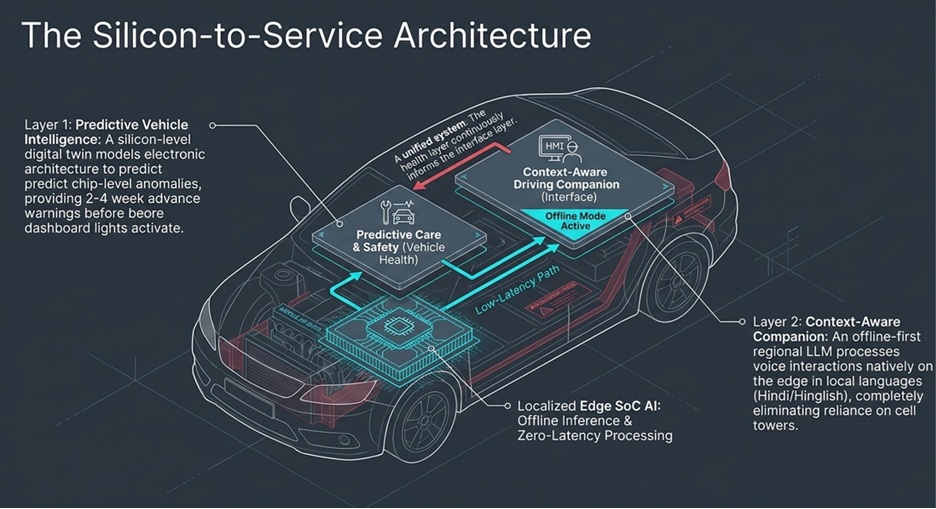
The automotive sector has become the primary laboratory for CPSoS orchestration. By 2026, the vehicle has evolved from a transport tool into a mobile energy storage unit and a critical grid node.
This transformation is powered by:
- Battery Management System (BMS) Optimization: AI-driven thermal control and cell balancing have maximized safety and lifespan, turning EVs into reliable assets for Vehicle-to-Grid (V2G) integration.
- Grid Stabilization: Through AI, vehicles now feed energy back into the smart grid during peak demand, acting as a decentralized power plant.
Technically, the car now operates in two distinct tiers: the Perception Layer and the Behavioral Layer. The Perception Layer (using LiDAR and sensor fusion) is a decentralized function where the vehicle understands its local environment. However, the Behavioral Layer is the level of orchestration, where traffic management and grid stability are managed as a collective System of Systems.
- Defensive Intelligence: The Shift to Zero-Trust AI Security
As AI physically affects human lives through braking systems and industrial robotics, “Security-by-Design” is no longer optional. The emerging threats of “model poisoning” and “adversarial manipulation” require a Zero-Trust AI Security architecture.
Leadership must deploy GUARDIAN-AI™ to establish a structured defense. This involves:
- The LLM Firewall: Protecting autonomous agents and language models from malicious prompts and data leaks.
- ISO/IEC 27090 Standards: Implementing specific controls for AI supply-chain assurance and model integrity.
- Adversarial Resilience: Building systems that can detect and respond to cybersecurity abnormalities in real-time.
By 2026, security is not just about data protection; it is about the physical resilience of the world we have built.
- The “System of Systems” Orchestration Challenge
The greatest hurdle for any 2026 enterprise is balancing decentralized vs. centralized control. Centralized authority is no longer feasible; the communication overhead of managing thousands of nodes in real-time would lead to system-level collapse.
To solve this, we rely on local data refinement. Each individual CPS node must act as an intelligent filter, performing its own data classification and labeling. Instead of flooding the network with raw data, local units extract and forward only the most critical “cognitive patterns.” This offloads complexity from the orchestration layer, allowing the broader System of Systems to adapt to environmental changes without being overwhelmed by the sheer volume of code being executed at the edge.
- Conclusion: A Human-Machine Symbiosis
The future of autonomy is not the removal of the human, but the perfection of our oversight. The Human-in-the-Loop philosophy ensures that while AI manages the scale and speed of a connected world, the human provides the “inspired decision.”
As we move deeper into this agentic verse, where compliance is automated and our vehicles stabilize the energy grid, we must face one final strategic question: In a world of total algorithmic efficiency, will your most valuable skill be the ability to provide the one thing AI cannot—the inspired, unpredictable decision?