1. The Genesis and Evolution of the Indian Regional Navigation Satellite System
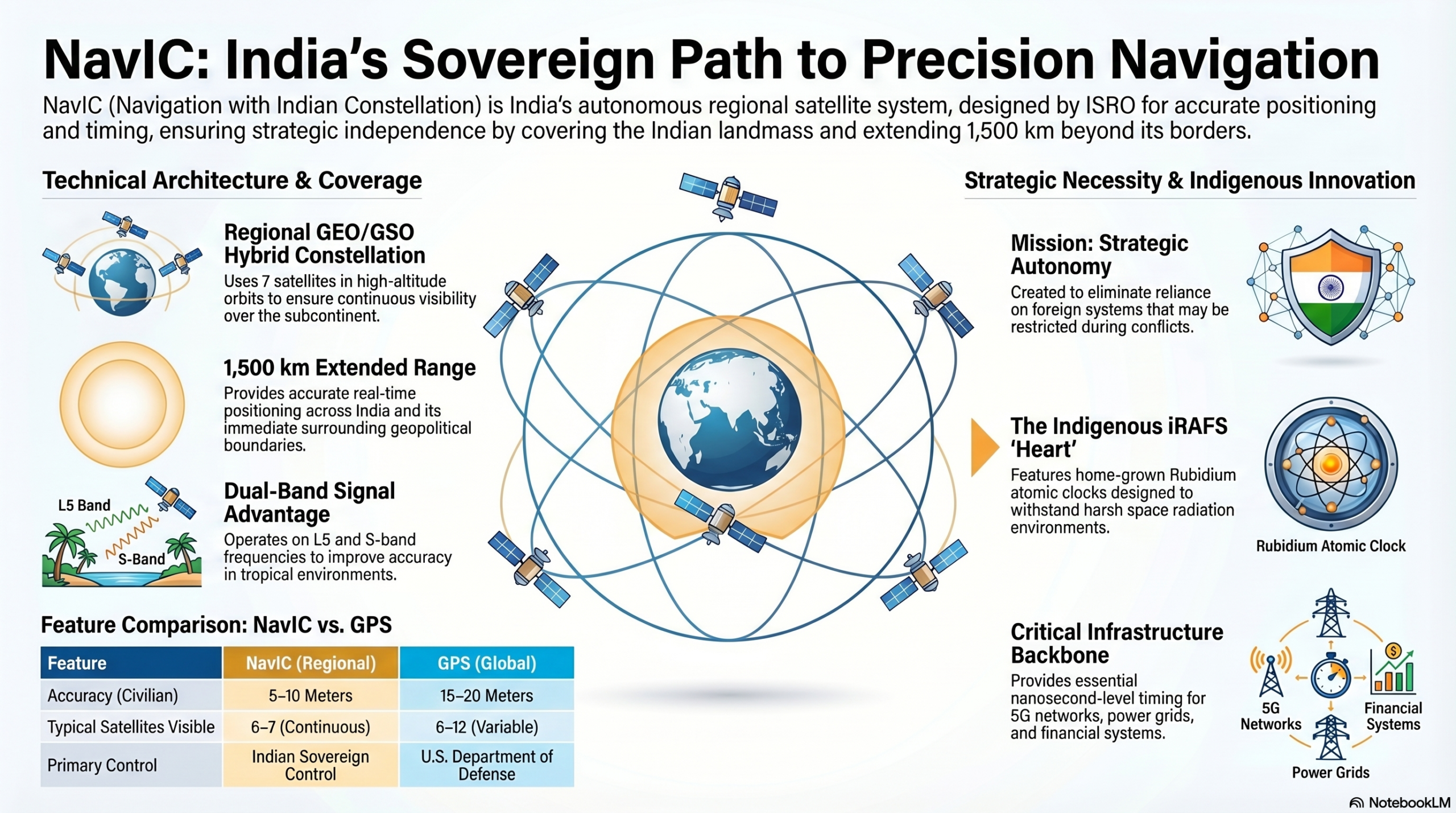
The development of the Indian Regional Navigation Satellite System (IRNSS), operationally branded as NavIC (Navigation with Indian Constellation), represents a paradigm shift in indigenous Positioning, Navigation, and Timing (PNT) doctrine. This strategic pivot was catalyzed by critical operational vulnerabilities exposed during the 1999 Kargil conflict, where the denial of high-precision Global Positioning System (GPS) data by the United States complicated Indian military maneuvers in high-altitude terrain. This historical lesson underscored that reliance on foreign-controlled dual-use infrastructure is a liability for an emerging superpower. Consequently, India pursued technological sovereignty through NavIC, an autonomous regional system providing a secure primary service area covering the Indian landmass and an extension of approximately 1,500 km beyond its borders.
This pursuit of regional autonomy mirrors global trends toward “technological sovereignty” exemplified by the European Union’s Galileo and China’s BeiDou. For India, maintaining a sovereign PNT capability is a non-negotiable requirement for national security, ensuring that critical defense and economic functions remain insulated from international geopolitical shifts. Beyond the strategic imperative, the system’s effectiveness is structurally rooted in its unique orbital mechanics, which provides a functional advantage over global Medium Earth orbit (MEO) constellations within the specified regional footprint.
2. Architecture and Atomic Engineering: The Hardware Backbone
NavIC’s architecture is a bespoke engineering solution to a specific geographic requirement. Unlike global systems like GPS or GLONASS, which utilize MEO configurations to achieve worldwide coverage, NavIC employs a hybrid Geostationary (GEO) and Inclined Geosynchronous (GSO) design. This allows the constellation to remain perpetually visible over the subcontinent, mitigating signal occlusion in the “urban canyons” of dense metropolises and the steep topography of the Himalayas.
|
System Parameter
|
NavIC Specification
|
Global MEO Systems (GPS/Galileo)
|
|
Space Segment
|
7 Satellites (3 GEO + 4 GSO/IGSO)
|
24–31 Satellites
|
|
Orbital Height
|
~35,786 km
|
~19,100 km to 23,222 km
|
|
Orbit Types
|
GEO (32.5°E, 83°E, 131.5°E)
|
Medium Earth Orbit (MEO)
|
|
GSO Equatorial Crossings
|
55°E and 111.75°E (two in each plane)
|
N/A
|
|
Inclination
|
29° (for GSO satellites)
|
Typically 55° to 64.8°
|
|
Atomic Clock Standard
|
Indigenous iRAFS / Imported RAFS
|
Rubidium / Caesium / Passive Maser
|
Atomic Clock Analysis
Precision navigation is inextricably linked to the stability of onboard timing references, where a mere 1-nanosecond error equates to a 30 cm distance error. While legacy NavIC satellites utilized imported rubidium clocks from Swiss SpectraTime, systemic failures prompted the development of the Indian Rubidium Atomic Frequency Standard (iRAFS). Engineered at the Space Applications Centre, the iRAFS features optimized SWaP parameters (<17 L, 7.5 kg, <30 W) and superior performance metrics, including a short-term stability of <1×10⁻¹² at 1s and a long-term stability of <5×10⁻¹⁴ at one day.
The performance of the NVS-01 satellite’s indigenous timing reference contrasts sharply with the systematic failure of legacy imported units. By internalizing this critical technology, India has corrected hardware vulnerabilities that previously threatened the longevity of the space segment. This robust hardware foundation enables superior performance metrics across the Indian subcontinent.
3. Benchmarking Accuracy and Signal Advantages
NavIC leverages a significant technical advantage in tropical environments through its dual-frequency signal structure. By broadcasting on both the L5 (1176.45 MHz) and S-band (2492.028 MHz), NavIC effectively mitigates ionospheric delay—the single largest source of error in single-frequency positioning. This is achieved via a physics-based delay calculation where the delay is inversely proportional to the square of the frequency (1/f2).
Performance Comparisons:
Horizontal Accuracy: NavIC provides a Standard Positioning Service (SPS) positional accuracy of approximately 5 meters, a significant improvement over the 15–20 meters associated with legacy civilian GPS.
Timing Accuracy: The system delivers timing precision better than 20–50 ns (2-sigma) relative to UTC, frequently achieving synchronization within 2–20 ns in operational testing.
- Ionospheric Mitigation: The dual-frequency (L5 + S-band) capability allows receivers to calculate atmospheric delay in real-time, providing superior accuracy in India’s dynamic tropical atmosphere.
From a strategic perspective, NavIC’s “Signal Availability” remains its most notable feature. Because its satellites are geosynchronous, 6 to 7 units remain perpetually visible over India. This “stable constellation” maintains signal lock in mountainous terrain where MEO satellites frequently pass behind obstructions. However, the operational resilience of this system remains contingent on maintaining a critical mass of functional assets.
4. Technical and Operational Hurdles: The 2025-2026 Crisis
Despite its technical sophistication, the NavIC constellation is currently navigating a period of degraded service. This “Sustainability Crisis” is characterized by the rapid attrition of first-generation satellites as they reach their end-of-life or suffer terminal clock failures. Following the failure of the final clock aboard IRNSS-1F on March 13, 2026, the constellation fell below the four-satellite threshold required for reliable 3D positioning. Assets like IRNSS-1C and IRNSS-1F are currently limited to one-way broadcast messaging rather than the ranging required for PNT.
Replenishment efforts faced a significant setback with the launch anomaly of NVS-02 on January 29, 2025. While the GSLV-F15 successfully reached a transfer orbit, the satellite failed to achieve its final station. Investigators identified a “pyro valve” failure in the oxidizer line as the root cause; a loose electrical contact in a connector prevented the explosive charge from receiving the signal to open the valve, affecting both primary and backup lines.
Defense Resistance Analysis: In contested environments, NavIC’s Restricted Service (RS) utilizes Binary Offset Carrier (BOC(5,2)) modulation. This structure provides high-grade resistance to narrow-band jamming and enhances multipath mitigation in electronic warfare scenarios. However, technological redundancy remains the primary bottleneck; without successful NVS-series launches, the system’s utility as a “national utility” remains precarious.
5. The Self-Sufficiency Audit: Chipsets and Infrastructure
India’s drive toward “Atmanirbhar Bharat” (Self-Reliant India) has achieved significant design milestones, yet remains tethered to foreign manufacturing for advanced silicon. The dichotomy between indigenous design and foreign fabrication is the final frontier for total defense autonomy.
Domestic Successes vs. Foreign Dependencies:
- Domestic: Development of iRAFS atomic clocks, sovereign ground control stations, and sophisticated “fabless” chipset designs from firms like Elena Geo Systems and Manjeera Digital Systems.
- Foreign: Elena Geo Systems’ high-performance 12nm NavIC chips are manufactured in Taiwan via contract foundries. While SCL Mohali maintains a domestic 180nm process, this is only sufficient for space-grade/strategic hardware and cannot meet the low-power requirements of consumer-grade smartphone chipsets.
Transitioning from “fabless design” to domestic “foundry capability” through the India Semiconductor Mission (ISM) is critical. Until India can manufacture 12nm/7nm silicon locally, its most advanced navigation hardware will remain vulnerable to international supply chain disruptions.
6. Strategic Importance: Security, Economy, and Critical Infrastructure
NavIC serves as a “force multiplier” in defense and an “efficiency driver” for civilian infrastructure. Its necessity is amplified by the “Strategic Asymmetry” created by China’s BeiDou system, which provides high-grade military navigation signals to regional adversaries like Pakistan. NavIC’s Restricted Service (RS) is thus the essential counterweight in the regional power balance.
- Defense: NavIC provides secure data for precision-guided munitions, border management in the Himalayas, and strategic surveillance of the Indian Ocean Region.
- Economic Infrastructure: The system facilitates power grid synchronization via Phasor Measurement Units (PMUs), financial transaction timestamping, and the stringent timing requirements of 5G telecommunications.
- Societal Benefit: ISRO utilizes the messaging interface for disaster management, broadcasting cyclone alerts to fishermen beyond cellular range. The government mandate for NavIC integration in smartphones after 2025 will further catalyze the domestic logistics ecosystem.
7. Conclusion: The Path to Global Competitiveness
The future trajectory of NavIC is defined by three pillars: Constellation Restoration, Indigenous Technological Maturation, and Global Integration. The immediate priority is the successful deployment of the NVS-series satellites to restore full 3D positioning capability. Concurrently, India must bridge the manufacturing gap by maturing domestic semiconductor fabrication and ensuring the continued reliability of the iRAFS standard.
NavIC is not merely a regional alternative to GPS; it is a symbol of India’s emergence as a technologically sovereign spacefaring power. By achieving interoperability with global standards—evidenced by integration into the iPhone 15—NavIC is poised to become a world-class standard, ensuring India charts its own course in an increasingly contested global PNT landscape.